Introduction to Set Theory
This page is still under construction
In set theory, the central object we study is (surprisingly) sets. Despite being the central object in the field, this course will not give formal definitions of this object. This is because mathematics, like any branch, is based on definitions and axioms that we agree are correct and from there we progress. Therefore, here we will use sets naively and intuitively without delving into the axioms according to which they behave. (But this is no excuse for non-formalism! Everything will still be formal and precise.)
Note: Domain of Discourse in Set Theory
In this field and in most of mathematics the domain of discourse is "Set Theory" itself, meaning all objects we talk about are sets, hence we will not include the domain of discourse in proofs anymore.
Note: Base Assumptions
All logic in this chapter is based on a system of axioms called \(\mathrm{ZF}\), beyond this chapter we will always use the axiom system \(\mathrm{ZFC}\) (we assume the axiom of choice in this course).
Sets🔗
Definition: Set (Non formal)
A set is a collection of elements without importance for order and without repetitions, it is commonly denoted by curly brackets \(\{\}\) between which are all the elements belonging to the set, or if all the elements cannot be listed, a certain rule for creating the elements.
Set Construction Schemes🔗
Now given what a set is, we want to understand how to construct sets.
There are three ways to define/build a set in set theory, the "Listing Method", the "Schema of Separation" and the "Set-Builder Notation using a Formula".
Listing Method🔗
The first method is the most straight-forward one, and just consist of defining a list of elements.
Definition: Listing Method
Let \(a_1, \ldots, a_n\) be objects, then we can build a set as,
Note
The "listing form" may also be called "roster form", "tabular form" or "extensional definition".
Example
We can build the following sets,
- \(\left\{1, \ldots, 100\right\}\) (Note that the use of ellipses in the definition of a set is prohibited unless the pattern is clear!)
- \(\left\{ \left\{ 1\right\} ,\left\{ 2\right\} \right\}\)
Definition: Singleton
A singleton is a set with only one element.
Formally, let \(a\) be an object, then the set \(\{a\}\) is called a singleton.
Definition: Element Belongs to a Set Constructed Using the Listing Method
Let \(a_1, \ldots, a_n\) be objects, and let \(a\) be an object, such that,
then we say that "\(a\) belongs to \(\{a_1, \ldots, a_n\}\)", and notate it using \(a \in \{a_1, \ldots, a_n\}\).
Note
We also use this equivalent phrases,
- \(a\) is in \(\{a_1, \ldots, a_n\}\).
- \(a\) is a member of \(\{a_1, \ldots, a_n\}\).
Example
Those are some examples on "belonging to a set",
- \(1 \in \{1\}\)
- \(\left\{ 1\right\} \in\left\{ \left\{ 1\right\} ,\left\{ 2\right\} ,1,2\right\}\)
- \(\left\{ 2,2\right\} \in\left\{ \left\{ 2\right\} \right\}\)
Schema of Separation🔗
The second method is actually an axiom in the \(\mathrm{ZF}\) axioms, and it what allows us to create sets from existing sets using a rule.
Axiom: Schema of Separation
Let \(A\) be a set, and let \(\varphi\) be a predicate over \(A\), then we can build a set as,Note
The "schema of separation" may also be called "schema of specification", "schema of restricted comprehension" or "set-builder notation".
Definition: Element Belongs to a Set Constructed Using the Schema of Separation
Let \(A\) be a set, let \(\varphi\) be a predicate over \(A\), and let \(a\) be an object, such that,then we say that "\(a\) belongs to \(\left\{ x\in A\mid\phi\left(x\right)\right\}\)", and notate it using \(a \in \left\{ x\in A\mid\phi\left(x\right)\right\}\).
Note
We also use this equivalent phrases,
- \(a\) is in \(\left\{ x\in A\mid\phi\left(x\right)\right\}\).
- \(a\) is a member of \(\left\{ x\in A\mid\phi\left(x\right)\right\}\).
Schema of Replacement🔗
The third method is also an axiom in the \(\mathrm{ZF}\) axioms, and it what allows us to create sets by altering elements from an existing set.
Axiom: Schema of Replacement
Let \(A\) be a set, and let \(f\) be an action on the elements of \(A\), then we can build a set as,
Note
The "schema of replacement" may also be called "set-builder notation".
Definition: Element Belongs to a Set Constructed Using the Schema of Replacement
Let \(A\) be a set, let \(f\) be an action on the elements of \(A\), and let \(a\) be an object, such that,
then we say that "\(a\) belongs to \(\{f\left(x\right)\mid x\in A\}\)", and notate it using \(a \in \{f\left(x\right)\mid x\in A\}\).
Note
We also use this equivalent phrases,
- \(a\) is in \(\{f\left(x\right)\mid x\in A\}\).
- \(a\) is a member of \(\{f\left(x\right)\mid x\in A\}\).
Set Construction Conventions🔗
Now that we know how to construct a set, and what does it mean for an object to be a member of a set, we can set a few conventions, and prove some things.
Definition: Element Doesn't Belongs to a Set
Let \(A\) be a set, and let \(a\) be an object, such that,
then we say that "\(a\) doesn't belong to \(A\)", and notate it using \(a \notin A\).
Note
We also use this equivalent phrases,
- \(a\) is not in \(A\).
- \(a\) is not a member of \(A\).
Example
Those are some examples on "not belonging to a set",
- \(\left\{ 3\right\} \notin\left\{ 1,2,3\right\}\).
- \(4 \notin \{0, 1, 2, 3\}\).
- \(5\notin \{x + 1\mid x \in \{5, 6, 7\}\}\).
Note
Let \(\varphi\) be a formula or a predicate, and let \(A\) be a set, then we will use the following notation,
to say that the object \(x\) comes from the set \(A\), and formally this is equivalent to the following,
Note
Let \(\varphi\) be a formula or a predicate, and let \(A\) be a set, then we will use the following notation,
to say that the object \(x\) comes from the set \(A\), and formally this is equivalent to the following,
Set of All Sets🔗
In the start of Set Theory the set construction schemes discussed above were not established, and it was accepted that any class of objects that can be expressed using a rule is a set, but that changed after an English mathematician named Bertrand Russell showed that there are paradoxes that arise from this assumption.
Theorem [Russell 1901]: Russell's Paradox
There exists a predicate \(\varphi\left(x\right)\) such that \(\{x \mid \varphi\left(x\right)\}\) isn't a set.Proof
We define the predicate as,
and now want to prove that \(A = \{x \mid \varphi\left(x\right)\}\) isn't a set.
For that we first note that either \(A \in A\) or \(A \notin A\), but we will now show that both cases are impossible,
- If \(A \in A\), then by the definition of element belongs to a set constructed using the schema of separation we know that \(\varphi\left(A\right)\) must be true, hence we know that \(A \notin A\), which is a contradiction to our assumption.
- If \(A \notin A\), then by the definition of element belongs to a set constructed using the schema of separation we know that \(\varphi\left(A\right)\) must be false, hence we know that \(A \in A\), which is again a contradiction to our assumption.
all in all we get that no matter what the set \(A\) can't exists since it creates a paradox.
Corollary: Set of All Sets
The set of all sets does't exists.
Formally, this means that there isn't a set \(\mathbb{S}\) such that,
Proof
We assume by contradiction that there is a set of all sets, meaning that there is a set \(\mathbb{S}\) such that,
then for every predicate \(\varphi\), we can define a set by the schema of separation like so,
but this is a contradiction to Russell's paradox.
Finite Cardinality🔗
There is another quantity that can be useful to know for sets, their cardinality, or informally their "size".
Definition: Finite Cardinality (Non formal)
Let \(a_1, \ldots, a_n\) be objects, then we define,
While this definition seems trivial and non-helpful, it will be a major topic in the end of the course.
Example
The following statements are true,
- \(\left|\{0, 1, 2\}\right| = 3\)
- \(\left|\{1, 2, 1, 2, 1\}\right| = 2\)
- \(\left|\{0.5, 0.6, 0.7, 0.8, 0.9, 1\}\right| = 6\)
Common Sets🔗
This are some base sets that are used everywhere in mathematics.
Empty Set🔗
The empty set is the trivially "empty" set, this set has no elements by construction, and while this set sounds as boring as a set can get, it actually has some unique properties we will explore later on.
Definition: Empty Set
Let \(\mathcal{E}\) be a set such that,
then we call \(\mathcal{E}\) an empty set.
Note: Cardinality of an Empty Set
Let \(\mathcal{E}\) be an empty set, then,
Integer Numbers🔗
Definition: Natural Numbers (Non formal)
A natural number is a positive whole number, and we use the following notation,
Definition: Positive Integers
Definition: Even Numbers
Definition: Odd Numbers
Definition: Integers (Non formal)
An integer is a whole number, and we use the following notation,
Induction🔗
Induction on Natural Numbers
Let \(P\) be a predicate over \(\bbn\), such that, \(P\left(0\right)\) is true, and, forall \(n\in\bbn\) if \(P\left(n\right)\) is true then \(P\left(n + 1\right)\) is true, then we can infer that,Proof
Formally we are trying to prove the following claim,
for that, we assume the prefix, and now try to prove the suffix.
Let's assume by contradiction that the suffix is not true, meaning that,
now since we know that such an \(n\) exists, we can choose \(k \in \bbn\) to be the minimal natural number for which \(\neg P\left(n\right)\) is true.
Now because we know that \(P\left(0\right)\) is true, we get that \(k \ge 1\), and hence \(k - 1 \in \bbn\). Then from the minimality of \(k\) we get that \(P\left(k - 1\right)\) is true, and from our assumption we get that
meaning that \(P\left(k\right)\) is true, which is a contradiction to the choosing of \(k\).
Claim
Let \(n\in\bbn\), then
Proof
We define a predicate \(P\left(n\right)\) to be the truth value of the equation,
Now we see that,
and hence \(P\left(0\right)\) is true.
Also, let \(k\in\bbn\) such that \(P\left(k\right)\), then we get that,
And finally from the induction theorem we get that \(\forall n\in \bbn. P\left(n\right)\), meaning that our original claim is true.
Rational Numbers🔗
Rational numbers are just fractions, a whole number divided by another whole number.
Definition: Rational Numbers
Example
The following numbers are rational,
- \(0.5 = \frac{1}{2}\)
- \(-0.75 = \frac{-3}{4}\)
- \(\frac{1}{2} = \frac{4}{8}\)
- \(0.333\ldots = \frac{1}{3}\)
- \(1 = \frac{1}{1}\)
- \(-5 = \frac{-5}{1}\)
Real Numbers🔗
The real numbers are way more difficult to define or give an intuitive meaning to.
The real numbers are all the numbers that lay on that "real line", which is the continuous version of the rational numbers line.
Definition: Real Numbers (Non formal)
And we can also define the positive real numbers,
Definition: Positive Real Numbers
Claim [Bernoulli 1689]: Bernoulli's Inequality
Let \(r\in\bbn\), and let \(x\in\bbr\) such that \(x\ge -1\), then,
Proof
We want to prove this claim using induction on \(r\).
Let \(r = 0\), then we get that,
as required.
Now let's assume that the claim holds for some \(r\in\bbn\), and try to prove the claim for \(r+1\), this can be done as follows,
And hence we get from the induction theorem that the claim is true.
Definition: Floor Value
Let \(x\in\bbr\), then we define,
Definition: Ceiling Value
Let \(x\in\bbr\), then we define,
Example
The following are examples for the ceil and floor values,
- \(\floor{1.1} = 1\)
- \(\ceil{1.1} = 2\)
- \(\floor{10.0} = 10\)
- \(\ceil{-5.4} = -5\)
- \(\ceil{0} = 0\)
- \(\floor{-0.5} = -1\)
Intervals🔗
An interval in a broad sense is a continuous section of the real numbers.
Definition: Open Interval
Let \(a, b\in\bbr\), then we define,
We also define,
and,
Definition: Open-Closed Interval
Let \(a, b\in\bbr\), then we define,
We also define,
Definition: Closed-Open Interval
Let \(a, b\in\bbr\), then we define,
We also define,
Definition: Closed Interval
Let \(a, b\in\bbr\), then we define,
Complex Numbers🔗
We will not define the complex numbers formally in this course since this is not needed, but for those who know what they are, this is the set notation and definition of them.
Definition: Complex Numbers
Containment and Equality🔗
The main thing we do with any object, is to compare it to other objects, for that we need to have a notion of "equality" between those objects.
Containment🔗
Informally, a set is contained in another set, if it contains only part of the elements of that set.
Definition: Containment
Let \(A\) and \(B\) be sets, such that,
then we say that "\(A\) is contained in \(B\)", and notate it using \(A\subseteq B\) or \(B \supseteq A\).
Moreover, we call \(A\) a subset of \(B\), and we call \(B\) a superset of \(A\).
Definition: Not Contained
Let \(A\) and \(B\) se sets, such that,
then we say that "\(A\) is not contained in \(B\)", and notate it using \(A\nsubseteq B\) or \(B \nsupseteq A\).
Definition: Proper Containment
Let \(A\) and \(B\) se sets, such that,
then we say that "\(A\) is proper contained in \(B\)", and notate it using \(A\subset B\) or \(B \supset A\).
Moreover, we call \(A\) a proper subset of \(B\), and we call \(B\) a proper superset of \(A\).
Example
The following are correct,
- \(\left\{ 1\right\} \nsubseteq\left\{ \left\{ 1\right\} \right\}\)
- \(\left\{ 1\right\} \subset\left\{ 1,2\right\}\)
- \(\left\{ 0\right\} \nsubseteq\left\{ 6, \bbn,\left\{8\right\}\right\}\)
Exercise
Prove the following results,
- \(\bbn_+ \subseteq \bbn\)
- \(\bbz \subseteq \bbq\)
- \(\bbr \subseteq \bbc\)
Solution
We prove each containment by showing that any element of the first set is necessarily an element of the second.
- Let \(n \in \bbn_+\), by the definition of \(\bbn_+\), we know that \(n \in \bbn\) and \(n \ge 1\). In particular, \(n \in \bbn\), thus, \(\bbn_+ \subseteq \bbn\).
- Let \(z \in \bbz\), we can write \(z\) as the fraction \(\frac{z}{1}\). Since \(z \in \bbz\) and \(1 \in \bbn_+\), by the definition of rational numbers, \(\frac{z}{1} \in \bbq\). Thus, \(z \in \bbq\), which implies \(\bbz \subseteq \bbq\).
- Let \(r \in \bbr\), we can write \(r\) in the complex form \(r + i \cdot 0\). Since \(r, 0 \in \bbr\), by the definition of complex numbers, \(r + i \cdot 0 \in \bbc\). Thus, \(r \in \bbc\), which implies \(\bbr \subseteq \bbc\).
Theorem: Empty Set is a Subset of Every Set
Let \(\mathcal{E}\) be an empty set, and let \(A\) be a set, then \(\mathcal{E} \subseteq A\).Proof
By the definition of a subset, to prove that \(\mathcal{E} \subseteq A\) we need to prove the following,
Let \(x\) be an object, then we want to prove that,
Now, notice that by the definition of an empty set it follows that \(x \notin \mathcal{E}\), hence the prefix in the implication is false, and by the definition of the implication connective we get that the original claim is true as required.
Claim: Containment is Transitive
Let \(A, B\) and \(C\) be sets, then,Proof
We assume that,
meaning that from the definition of containment we know that,
and,
Now from the definition of containment we have to prove that,
Let \(x\) be an object such that \(x \in A\), then from our assumption we get that, \(x \in B\), and again from our assumption we get that \(x \in C\), as required.
Equality🔗
Now that we know what it means for a set to be contained in another set we can talk about sets being equal, this is because equality of sets means that both sets share the same elements, or formally that they are contained in each other.
Moreover, since this is a basic and useful definition, this is actually an axiom of our mathematical theory.
Axiom: Axiom of Extensionality
Let \(A\) and \(B\) be sets, such that,then we say that \(A\) is equal to \(B\), and notate it using \(A = B\).
Exercise
Let \(A\) and \(B\) be sets, then,
Solution
We prove the equivalence by showing both directions of the implication:
-
\(\underline{\implies}\): Assume \(A = B\), by the axiom of extensionality, we know that
\[\forall x.(x \in A \iff x \in B)\]This implies both
\[\forall x.(x \in A \implies x \in B)\]and,
\[\forall x.(x \in B \implies x \in A)\]Thus, by the definition of containment, \(A \subseteq B\) and \(B \subseteq A\).
-
\(\underline{\impliedby}\): Assume \(A \subseteq B\) and \(B \subseteq A\), by the definition of containment, this means that,
\[\forall x.(x \in A \implies x \in B)\]and,
\[\forall x.(x \in B \implies x \in A)\]Combining these gives by the definition of iff,
\[\forall x.(x \in A \iff x \in B)\]Therefore, by the axiom of extensionality, \(A = B\).
Claim: Uniqueness of the Empty Set
Let \(A\) and \(B\) be empty sets, then \(A = B\).Proof
We need to prove that \(A = B\), from the last exercise it suffices to prove that,
Now by the theorem that an empty set is a subset of every set we get that \(A \subseteq B\) and \(B \subseteq A\) since both are empty sets (we applied the theorem on both) as required.
After proving that all empty sets are equal, we can define a singular universal empty set.
Definition: The Empty Set
We notate the only empty set using \(\emptyset\).
Note
It is also common to see the notation \(\{\}\) for the empty set.
Operations on Sets🔗
We talked about sets as if they are singular in their world, but now we want to start talking about different operations we can do on sets.
First of all we want to have a way to visualize all those operations,
Note: Venn Diagram
A Venn diagram is a diagram with the sole purpose of showing the relations between different sets. We will draw a set as a circle in the diagram, an element of a set as a point, and we will use color for the topic of the diagram.
Example: Venn Diagram of Containment
Let \(A\) and \(B\) be sets, such that \(B\subseteq A\), then we can draw for them the following diagram,
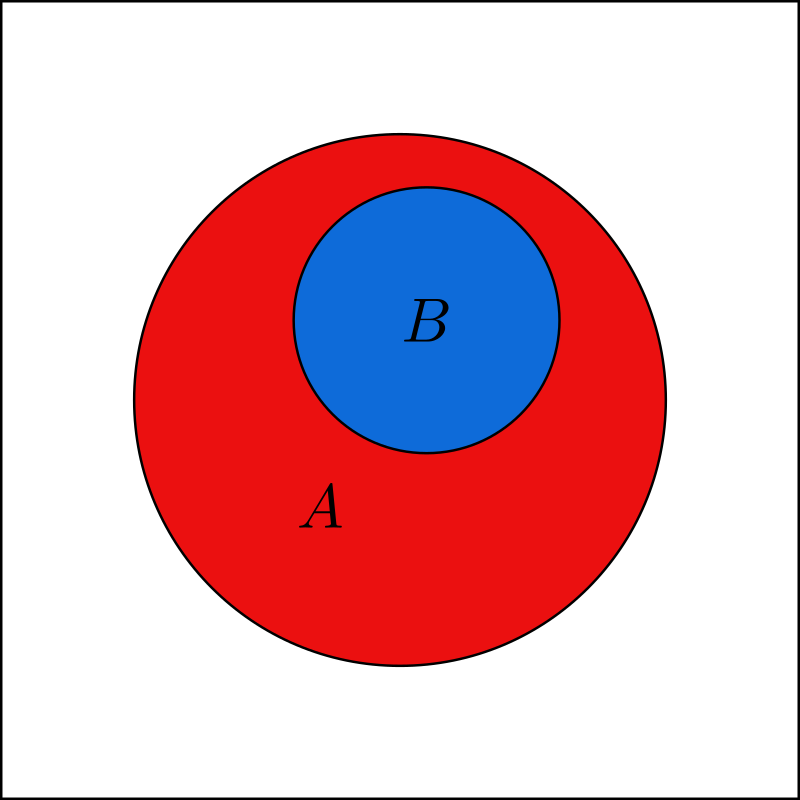
Venn Diagram of Containment
Intersection🔗
The first operation we define on sets is the intersection operation that acts like an "and" on two sets.
Definition: Intersection
Let \(A\) and \(B\) be sets, then,
And as a Venn diagram,
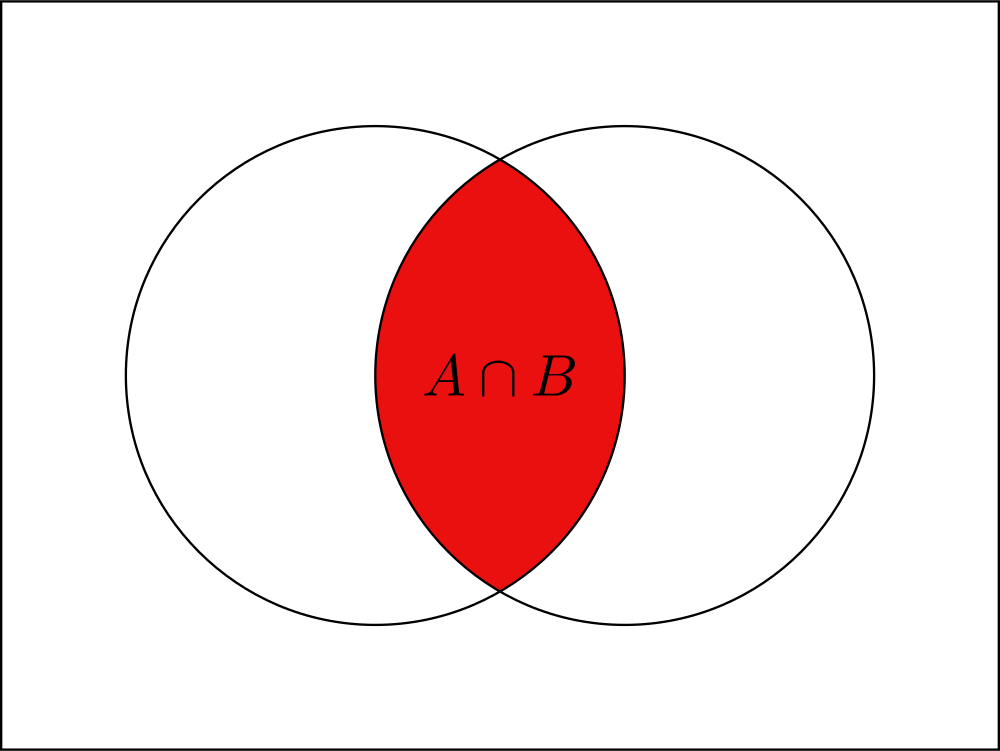
Venn Diagram of Intersection
Example
Try to understand why the following are correct,
- \(\left\{ 1,2,3\right\} \cap\left\{ 3,4,5,6\right\} =\left\{ 3\right\}\)
- \(\left\{ \left\{ 1\right\} \right\} \cap\left\{ 1\right\} =\emptyset\)
- \(\left\{ 3,4\right\} \cap\left\{ 3,4,5\right\} =\left\{ 3,4\right\}\)
- \(\bbn \cap \bbz = \bbn\)
Claim: Intersection is Associative
Let \(A, B\) and \(C\) be sets, then,
Proof
Let \(x\) be an object, then, to prove this, we use the definition of the intersection, and the fact that the conjunction connective is associative,
And from the definition of equality we get that the sets are equal.
Note: Without Loss of Generality
In the proof above and in a lot of proofs across mathematics, we see a lot of inner repetitions, in those cases we allow ourselves to use a "symmetry argument" or "without los of generality argument" (WLoG), these allow us to assume that some parts of the proof are skippable since they are identical to things we've already proofed. Note that using those arguments requires training and will become simpler with time, and from now on we will use those in the proofs to make them shorter and easier to read but also to allow the reader to familiarize himself with this technic.
Claim: Intersection is Commutative
Let \(A\) and \(B\) be sets, then,
Proof
Let \(x\) be an object, then, to prove this, we use the definition of the intersection, and the fact that the conjunction connective is commutative,
And from the definition of equality we get that the sets are equal.
Claim: Intersection is Idempotent
Let \(A\) be a set, then,
Proof
Let \(x\) be an object, to prove this, we use the definition of the intersection, and the fact that the conjunction connective is idempotent,
And from the definition of equality we get that the sets are equal.
Exercise
Let \(A\) be a set, then,
Solution
Let \(x \in A \cap \emptyset\). Then \(x \in A \land x \in \emptyset\). Since \(x \in \emptyset\) is false for all \(x\), the conjunction is always false.
Thus, \(A \cap \emptyset\) contains no elements, and from the uniqueness of the empty set we get that \(A \cap \emptyset = \emptyset\).
Generalized Intersection🔗
We also want to be able to take the intersection of many sets at once, for that we can use the generalized intersection.
But first we have to define the object on which we take the generalized intersection,
Definition: Family of Sets
A set \(\mathcal{F}\) is called a "family of sets", if for all \(X \in \mathcal{F}\) we have that \(X\) is a set.
Now we can define non formally the generalized intersection as,
Definition: Generalized Intersection (Non formal)
Let \(\mathcal{F}\) be a family of sets, then,
The problem we have is that the set on the right of the definition doesn't adhere to our set construction schemes, so to define this properly we have to somehow pick a set from which all the \(x\)s are from, for that we can try to just pick an arbitrary set and see where it gets us.
Theorem: Generalized Intersection is Well Defined
Let \(\mathcal{F}\) be a family of sets, and let \(A, B\in\mathcal{F}\), then,
Proof
We show that any element in the first set must be in the second, and vice versa:
-
\(\underline{\subseteq}\): Let
\[x \in \{x \in A \mid \forall X \in \mathcal{F}. x \in X\}\]Then \(x \in A\) and for all \(X \in \mathcal{F}\) we know that \(x \in X\).
Since \(B \in \mathcal{F}\), it follows that \(x \in B\), thus, \(x\) satisfies the conditions for,
\[\{x \in B \mid \forall X \in \mathcal{F}. x \in X\}\] -
\(\underline{\supseteq}\): By symmetry (WLoG), swapping \(A\) and \(B\) in the argument above shows that any element in the second set is also in the first.
Since both sets contain the same elements, they are equal.
Now that we've cleared that the choice of set from the family isn't important we can give the full formal definition,
Definition: Generalized Intersection
Let \(\mathcal{F}\) be a family of sets, and let \(A\in\mathcal{F}\), then,
We also allow for sugar-syntax,
-
Let \(I\) be a set, and let \(\left\{A_\lambda \mid \lambda \in I\right\}\) be a family of sets, then,
\[\bigcap_{\lambda \in I}A_\lambda = \bigcap\left\{A_\lambda \mid \lambda \in I\right\}\] -
Let \(\left\{A_i \mid i\in\bbn\right\}\) be a family of sets, then,
\[\bigcap_{i = 0}^{\infty} A_i = \bigcap_{i \in \bbn} A_i\]
Because we know that the generalized intersection is well defined, we will omit the set \(A\) from now on, because it doesn't provide us with any information.
Example
Try to understand why the following is true,
- \(\bigcap_{i=0}^{\infty}\left\{ n\in\bbn\mid n\ge i\right\} =\emptyset\)
- \(\bigcap_{\varepsilon\in\bbr_{+}}\left[0,\varepsilon\right)=\left\{ 0\right\}\)
- \(\bigcap_{n=1}^{\infty}\left(-\frac{1}{n},\frac{1}{n}\right)=\left\{ 0\right\}\)
Exercise
Let \(B\) be a set, and let \(\mathcal{F}\) be a family of sets, then,
Solution
We prove the equivalence as follows,
-
\(\underline{\implies}\): Assume the prefix, meaning that, \(B \subseteq \bigcap \mathcal{F}\).
Let \(X \in \mathcal{F}\) be an arbitrary set. Since \(\bigcap \mathcal{F} \subseteq X\) by definition, and because containment is transitive we get that \(B \subseteq X\).
-
\(\underline{\impliedby}\): Assume that for all \(X \in \mathcal{F}\), we have that, \(B \subseteq X\).
Now let \(b \in B\), then for all \(X \in \mathcal{F}\), we have \(b \in X\) (since \(B \subseteq X\)). By the definition of generalized intersection, \(b \in \bigcap \mathcal{F}\). Thus, \(B \subseteq \bigcap \mathcal{F}\).
Claim
Let \(\mathcal{F}\) be a family of sets, and let \(A\in\mathcal{F}\), then,
Proof
Let \(x\in \bigcap\mathcal{F}\), by the definition of containment, we have to prove that \(x\in A\).
By the definition of the generalized intersection, we know that \(\forall X\in\mathcal{F}. x\in X\), hence it also follows for our set \(A\), meaning that \(x\in A\) as required.
Disjoint Sets🔗
Definition: Disjoint Sets
Let \(A\) and \(B\) be sets, such that,
then, \(A\) and \(B\) are called disjoint sets.
And as a Venn diagram,
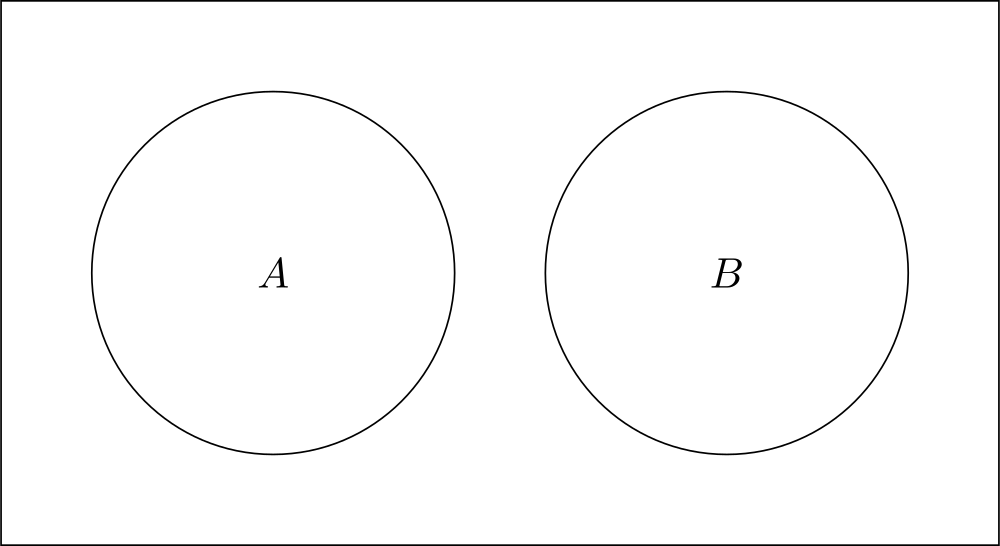
Venn Diagram of Disjoint Sets
Definition: Family of Disjoint Sets
Let \(\mathcal{F}\) be a family of sets, such that,
then, \(\mathcal{F}\) is called a family of disjoint sets.
Definition: Family of Pairwise Disjoint Sets
Let \(\mathcal{F}\) be a family of sets, such that,
then, \(\mathcal{F}\) is called a family of pairwise disjoint sets.
Exercise: Pairwise Disjoint Implies Disjoint
Let \(\mathcal{F}\) be a family of pairwise disjoint sets, such that there exists sets \(A, B\in\mathcal{F}\) for which \(A\ne B\), then, \(\mathcal{F}\) is a family of disjoint sets.
Solution
Assume \(\mathcal{F}\) is a family of pairwise disjoint sets.
By the definition of pairwise disjoint sets, \(A \cap B = \emptyset\). We know that \(\mathcal{F}\subseteq A\) and also \(\mathcal{F}\subseteq B\), hence we get that \(\mathcal{F}\subseteq A\cap B\), meaning that \(\mathcal{F}\subseteq\emptyset\). Moreover, by the theorem that the empty set is a subset of every set, we get that \(\bigcap \mathcal{F} = \emptyset\), meaning that \(\mathcal{F}\) is a family of disjoint sets.
Union🔗
This operation on sets is the union operation, and it acts like a "or" on two sets.
Definition: Union (Non formal)
Let \(A\) and \(B\) be sets, then,
But this definition doesn't adhere to our set construction schemes, hence we need to somehow know in the definition from which set are all the \(x\)s come from, but this is cyclic problem since the union is exactly the set from which we would have wanted to draw the \(x\)s from. Because of that, to define this operation in our theory we have to an axiom that allows us to use the union operation,
Axiom: Axiom of Union
Let \(\mathcal{F}\) be a family of sets, then there exists a set \(\mathcal{U}\), such that,
and we call such a set \(\mathcal{U}\) a world of \(\mathcal{F}\).
Before we define the union operator we want to show that it will be well defined,
Theorem: Union is Well Defined
Let \(A\) and \(B\) be sets, and let \(\mathcal{U}, \mathcal{V}\) be worlds of \(\left\{A, B\right\}\), then,
Proof
Let
This means \((y \in A) \lor (y \in B)\). Since \(\mathcal{V}\) is a world of \(\{A, B\}\), if \(y \in A\) then \(y \in \mathcal{V}\), and if \(y \in B\) then we get that \(y \in \mathcal{V}\). In either case, \(y \in \mathcal{V}\). Thus,
By swapping the roles of \(\mathcal{U}\) and \(\mathcal{V}\), we get the reverse containment. Therefore, the union is well defined.
And now we can define union formally,
Definition: Union
Let \(A\) and \(B\) be sets, and let \(\mathcal{U}\) be a world of \(\left\{A, B\right\}\), then,
And as a Venn diagram,
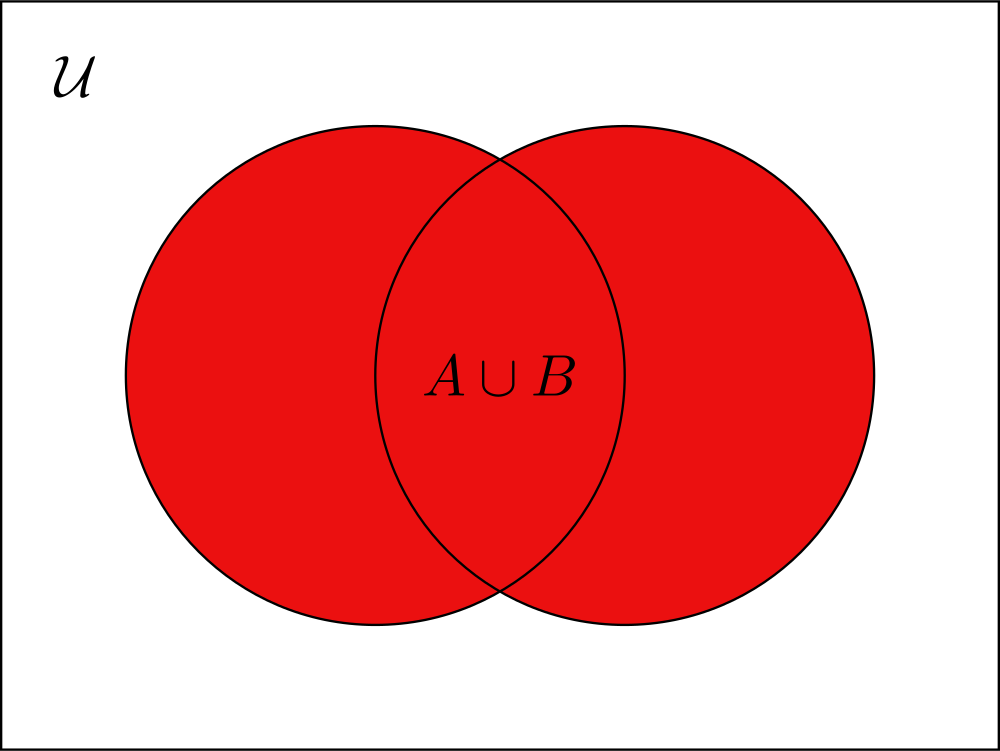
Venn Diagram of Union
Because we know that the union is well defined, we will omit the world \(\mathcal{U}\) from now on, because it doesn't provide us with any information.
Example
Try to understand why the following are correct,
- \(\left\{ 1,2,3\right\} \cup\left\{ 3,4,5,6\right\} =\left\{ 1,2,3,4,5,6\right\}\)
- \(\left\{ \left\{ 1\right\} \right\} \cup\left\{ 1\right\} =\left\{ 1,\left\{ 1\right\} \right\}\)
- \(\bbn\cup\bbr=\bbr\)
- \(\bbn_{\even}\cup\bbn_{\odd}=\bbn\)
Claim: Union is Associative
Let \(A, B\) and \(C\) be sets, then,
Proof
Let \(x\) be an object, to prove this, we use the definition of the union, and the fact that the disjunction connective is associative,
And from the definition of equality we get that the sets are equal.
Claim: Union is Commutative
Let \(A\) and \(B\) be sets, then,
Proof
Let \(x\) be an object, to prove this, we use the definition of the union, and the fact that the disjunction connective is commutative,
And from the definition of equality we get that the sets are equal.
Claim: Union is Idempotent
Let \(A\) be a set, then,
Proof
Let \(x\) be an object, to prove this, we use the definition of the union, and the fact that the disjunction connective is idempotent,
And from the definition of equality we get that the sets are equal.
Exercise
Let \(A\) be a set, then,
Solution
Let \(x\) be an object, to prove this, we use the definition of the union, and the fact that the empty set is empty,
Thus, \(A \cup \emptyset = A\).
Claim: Union is Distributive Over Intersection
Let \(A\), \(B\) and \(C\) be sets, then,
Proof
Let \(x\) be an object, to prove this, we use the definition of the union and intersection, and the fact that that the disjunction connective is distributive over the conjunction connective,
Since the truth conditions are identical, the sets are equal.
Exercise: Intersection is Distributive Over Union
Let \(A\), \(B\) and \(C\) be sets, then,
Solution
Let \(x\) be an object, to prove this, we use the definition of the union and intersection, and the fact that that the conjunction connective is distributive over the disjunction connective,
Since the truth conditions are identical, the sets are equal.
Generalized Union🔗
We also want to be able to take the union of many sets at once, for that we can use the generalized union.
Non formally we can define the generalized union as,
Definition: Generalized Union (Non formal)
Let \(\mathcal{F}\) be a family of sets, then,
But we already saw this problem earlier with the union operator, hence we can solve it here the same way,
Theorem: Generalized Union is Well Defined
Let \(\mathcal{F}\) be a family of sets, and let \(\mathcal{U}, \mathcal{V}\) be worlds of \(\mathcal{F}\), then,
Proof
Let \(x \in \{x \in \mathcal{U} \mid \exists X \in \mathcal{F}. x \in X\}\). Then there exists some \(X \in \mathcal{F}\) such that \(x \in X\). By the definition of a world \(\mathcal{V}\) for \(\mathcal{F}\), since \(X \in \mathcal{F}\), we must have \(X \subseteq \mathcal{V}\), and therefore \(x \in \mathcal{V}\).
This shows \(x \in \{x \in \mathcal{V} \mid \exists X \in \mathcal{F}. x \in X\}\). The reverse direction is identical by swapping \(\mathcal{U}\) and \(\mathcal{V}\).
Therefore, the generalized union is well defined.
Definition: Generalized Union
Let \(\mathcal{F}\) be a family of sets, and let \(\mathcal{U}\) be a world of \(\mathcal{F}\), then,
We also allow for sugar-syntax,
-
Let \(I\) be a set, and let \(\left\{A_\lambda \mid \lambda \in I\right\}\) be a family of sets, then,
\[\bigcup_{\lambda \in I}A_\lambda = \bigcup\left\{A_\lambda \mid \lambda \in I\right\}\] -
Let \(\left\{A_i \mid i\in\bbn\right\}\) be a family of sets, then,
\[\bigcup_{i = 0}^{\infty} A_i = \bigcup_{i \in \bbn} A_i\]
Because we know that the generalized union is well defined, we will omit the world \(\mathcal{U}\) from now on, because it doesn't provide us with any information.
Example
Try to understand why the following is true,
- \(\bigcup_{i=0}^{\infty}\left\{ i\right\} =\bbn\)
- \(\bigcup_{i=0}^{\infty}\left(i,i+1\right)=\bbr_{+}\backslash\bbn\)
- Let \(\e \in \bbr_+\) then, \(\bigcup_{q\in\bbq}\left(q-\e,q+\e\right)=\bbr\)
Exercise
Let \(B\) be a set, and let \(\mathcal{F}\) be a family of sets, then,
Solution
We prove the equivalence as follows:
- \(\underline{\implies}\): Assume \(\bigcup \mathcal{F} \subseteq B\). Let \(X \in \mathcal{F}\) be an arbitrary set. Since \(X \subseteq \bigcup \mathcal{F}\) by definition, transitivity of containment implies \(X \subseteq B\).
- \(\underline{\impliedby}\): Assume that for all \(X \in \mathcal{F}\), we have that, \(X \subseteq B\). Let \(x \in \bigcup \mathcal{F}\), then there exists some \(X_0 \in \mathcal{F}\) such that \(x \in X_0\). By our assumption, \(X_0 \subseteq B\), so \(x \in B\). Thus, \(\bigcup \mathcal{F} \subseteq B\).
The following exercise is very challenging, and hence it's marked with "⭐". This exercise requires understanding of the real numbers and it's relation to the rational numbers.
Exercise⭐
Prove the following two results,
- \(\bigcap_{n\in\bbn_{+}}\left(\bigcup_{q\in\bbq}\left(q-\frac{1}{n},q+\frac{1}{n}\right)\right)=\bbr\)
- \(\bigcup_{q\in\bbq}\left(\bigcap_{n\in\bbn_{+}}\left(q-\frac{1}{n},q+\frac{1}{n}\right)\right)=\bbq\)
Solution
-
To prove that,
\[\bigcap_{n\in\bbn_{+}}\left(\bigcup_{q\in\bbq}\left(q-\frac{1}{n},q+\frac{1}{n}\right)\right)=\bbr\]we will use the definition of equality as bidirectional containment,
-
\(\underline{\subseteq}\): Let \(n_0 \in \bbn_+\), and let \(q_0 \in \bbq\), then from the definition of an interval we get that,
\[\left(q-\frac{1}{n},q+\frac{1}{n}\right)\subseteq \bbr\]And since it's correct for all \(q_0\in\bbq\), we get that,
\[\bigcup_{q\in\bbq}\left(q-\frac{1}{n},q+\frac{1}{n}\right) \subseteq \bbr\]Now since it also true for all \(n_0\in\bbn_+\), we get that,
\[\bigcap_{n\in\bbn_{+}}\left(\bigcup_{q\in\bbq}\left(q-\frac{1}{n},q+\frac{1}{n}\right)\right)\subseteq\bbr\] -
\(\underline{\supseteq}\): Let \(x \in \bbr\). We need to show that,
\[x \in \bigcup_{q\in\bbq}\left(q-\frac{1}{n}, q+\frac{1}{n}\right)\]for any \(n \in \bbn_+\).
Let \(n \in \bbn_+\), and define \(q_0 = \frac{\floor{nx}}{n}\), now since, \(\floor{nx} \in \bbz\), we get that, \(q_0 \in \bbq\). And from the properties of the floor function,
\[\floor{nx} \le nx < \floor{nx} + 1\]Meaning that,
\[q_0 \le x < q_0 + \frac{1}{n}\]This implies that,
\[|x - q_0| < \frac{1}{n}\]Thus,
\[x \in \left(q_0 - \frac{1}{n}, q_0 + \frac{1}{n}\right)\]And since \(q_0 \in \bbq\), we have that,
\[x\in \bigcup_{q\in\bbq}\left(q-\frac{1}{n}, q+\frac{1}{n}\right)\]as required.
-
-
To prove that,
\[\bigcup_{q\in\bbq}\left(\bigcap_{n\in\bbn_{+}}\left(q-\frac{1}{n},q+\frac{1}{n}\right)\right)=\bbq\]we will prove a stronger statement, let \(q_0 \in \bbq\), then,
\[\bigcap_{n\in\bbn_{+}}\left(q_0-\frac{1}{n},q_0+\frac{1}{n}\right) = \left\{q_0\right\}\]and for that we will use the definition of equality as bidirectional containment,
-
\(\underline{\subseteq}\): Let
\[x\in\bigcap_{n\in\bbn_{+}}\left(q_0-\frac{1}{n},q_0+\frac{1}{n}\right)\]and assume by contradiction that \(x \ne q_0\). Then we define \(]\delta = \left|x - q_0\right|\), and notice that there exists \(n_0\in\bbn_+\) such that,
\[\frac{1}{n} < \delta\]meaning that,
\[x\notin \left(q_0-\frac{1}{n_0},q_0+\frac{1}{n_0}\right)\]Hence, by the definition of the generalized intersection we get that,
\[x\notin \bigcap_{n\in\bbn_{+}}\left(q_0-\frac{1}{n},q_0+\frac{1}{n}\right)\]which is a contradiction to our assumption, meaning that \(x = q_0\).
-
\(\underline{\supseteq}\): We want to prove that,
\[\bigcap_{n\in\bbn_{+}}\left(q_0-\frac{1}{n},q_0+\frac{1}{n}\right) \supseteq \left\{q_0\right\}\]meaning that,
\[q_0 \in \bigcap_{n\in\bbn_{+}}\left(q_0-\frac{1}{n},q_0+\frac{1}{n}\right)\]For that, let \(n_0 \in \bbn_+\), then we need to show that,
\[q_0 \in \left(q_0-\frac{1}{n},q_0+\frac{1}{n}\right)\]but this is true since,
\[q_0 - \frac{1}{n} < q_0 < q_0 + \frac{1}{n}\]as required.
-
Disjoint Union🔗
Definition: Disjoint Union
Let \(A\) and \(B\) be disjoint sets, then,
And as a Venn diagram,
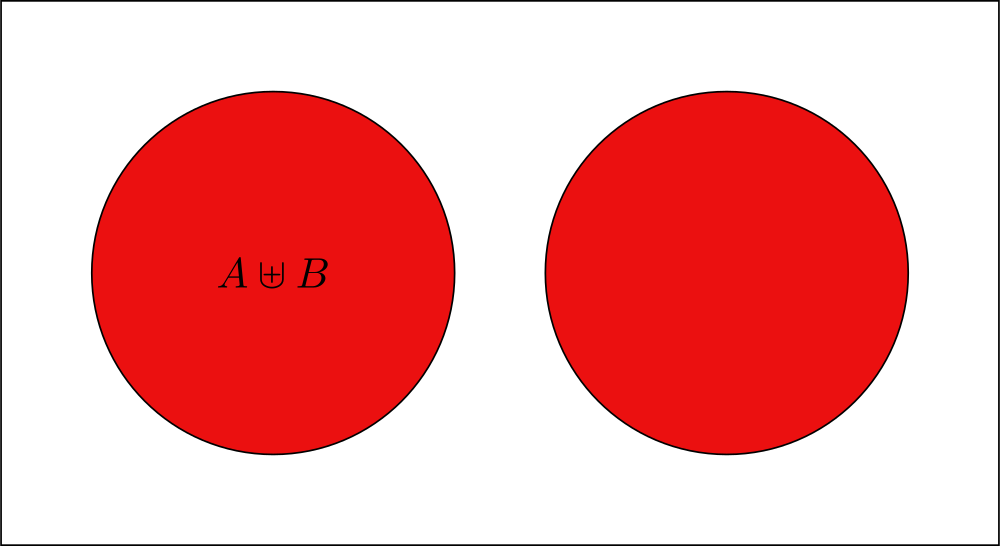
Venn Diagram of Disjoint Union
Definition: Generalized Disjoint Union
Let \(\mathcal{F}\) be a family of pairwise disjoint sets, then,
We also allow for sugar-syntax,
-
Let \(I\) be a set, and let \(\left\{A_\lambda \mid \lambda \in I\right\}\) be a family of pairwise disjoint sets, then,
\[\biguplus_{\lambda \in I}A_\lambda = \biguplus\left\{A_\lambda \mid \lambda \in I\right\}\] -
Let \(\left\{A_i \mid i\in\bbn\right\}\) be a family of pairwise disjoint sets, then,
\[\biguplus_{i = 0}^{\infty} A_i = \biguplus_{i \in \bbn} A_i\]
Example
Try to understand why the following is true,
- \(\biguplus_{z\in\bbz}\left(z,z+1\right)=\bbr\backslash\bbz\)
- \(\left\{ 1\right\} \uplus\left\{ 2\right\} =\left\{ 1,2\right\}\)
- \(\left\{ \left\{ 1\right\} \right\} \uplus\left\{ 1\right\} =\left\{ 1,\left\{ 1\right\} \right\}\)
Note
Let \(A\) and \(B\) be finite disjoint sets, then,
Difference🔗
Definition: Difference
Let \(A\) and \(B\) be sets, then,
And as a Venn diagram,
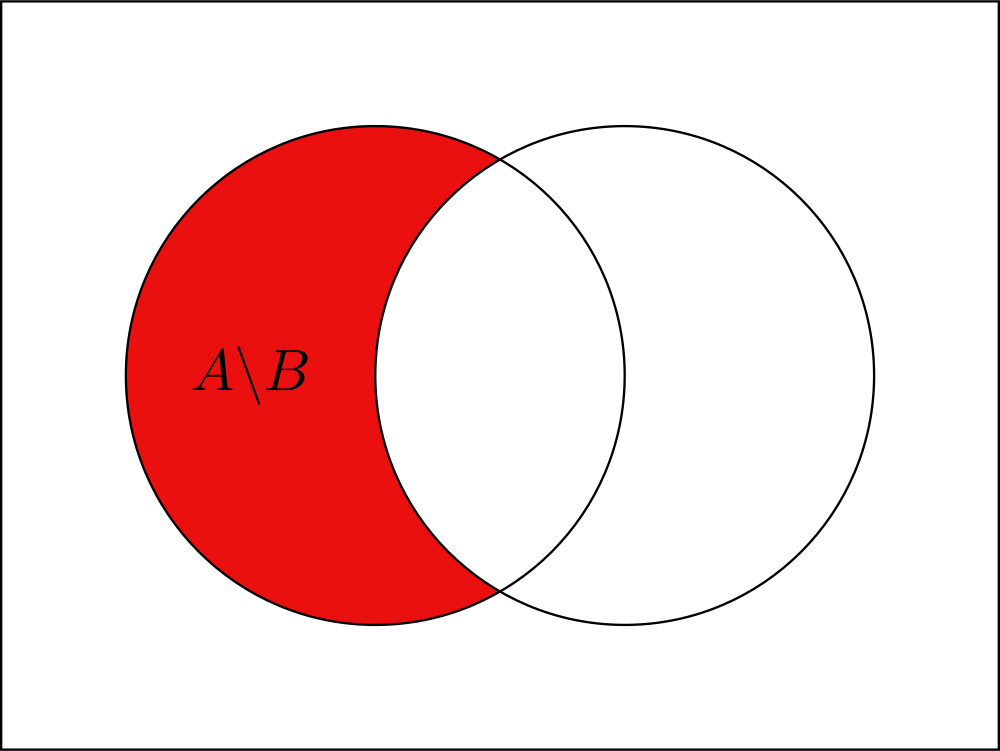
Venn Diagram of Difference
Note
The "difference" operation may also be called "relative complement".
And the notation \(A - B\) may be used instead of \(A\backslash B\).
Example
Try to understand why the following is true,
- \(\left\{ 1,2,3\right\} \backslash\left\{ 3,4,5,6\right\} =\left\{ 1,2\right\}\)
- \(\left\{ \left\{ 1\right\} \right\} \backslash\left\{ 1\right\} =\left\{ \left\{ 1\right\} \right\}\)
- \(\left\{ 3,4\right\} \backslash\left\{ 3,4,5\right\} =\emptyset\)
- \(\bbn\backslash\bbn_{+}=\left\{ 0\right\}\)
Definition: Irrational Numbers
We define the irrational numbers to be the following set, \(\bbr \backslash \bbq\).
Claim
Let \(A\) be a set, then,
Proof
Let \(x\) be an object, to prove this, we use the definition of the difference,
Thus, by the uniqueness of the empty set \(A \backslash A = \emptyset\).
Exercise
Let \(A\) be a set, then,
Solution
Let \(x\) be an object, to prove this, we use the definition of the difference, and the definition of the empty set,
Thus, \(A \backslash\emptyset = A\).
Claim
Let \(A\) and \(B\) be sets, then, the following are equivalent (TFAE),
- \(A\subseteq B\)
- \(A\cap B = A\)
- \(A\backslash B = \emptyset\)
- \(A\cup B = B\)
Proof
We prove the equivalence by following a cycle of implications,
as follows,
- \(\underline{1 \implies 2}\): We assume the prefix, meaning that \(A\subseteq B\),
- \(\underline{\supseteq}\): Let \(x \in A\). Since \(A \subseteq B\), we know that, \(x \in B\). Thus \(x \in A \cap B\).
- \(\underline{\subseteq}\): From a previous result we have that \(A \cap B \subseteq A\) is always true.
- \(\underline{2 \implies 3}\): We assume that \(A \cap B = A\). If \(A\backslash B\) is not the empty set, there must be an element in it, let's call it \(x \in A \backslash B\), then \(x \in A\) and \(x \notin B\). But \(x \in A\) implies \(x \in A \cap B\), so \(x \in B\), a contradiction.
- \(\underline{3 \implies 4}\): We assume that \(A \backslash B = \emptyset\),
- \(\underline{\subseteq}\): Let \(x \in A \cup B\). If \(x \in B\), we are done. If \(x \in A\), then since \(A \backslash B = \emptyset\), \(x\) cannot be in \(A\) without being in \(B\) (because if it was then \(x\in A\backslash B\) meaning that \(x \in \emptyset\)), so \(x \in B\). Hence no matter what we get that \(x\in B\), meaning that \(A\cup B \subseteq B\).
- \(\underline{\supseteq}\): Let \(x\in B\), then \(x\in A\cup B\) by the definition of union, hence \(B\subseteq A\cup B\).
- \(\underline{4 \implies 1}\): We assume that \(A\cup B = B\). Let \(x \in A\), then \(x \in A \cup B\), and since \(A \cup B = B\), it follows that \(x \in B\). Hence \(A \subseteq B\).
Note
Let \(A\) and \(B\) be finite sets, such that \(B\subseteq A\), then,
Complement🔗
Definition: Complement
Let \(A\) be a set, and let \(\mathcal{U}\) be a world of \(\left\{A\right\}\), then,
And as a Venn diagram,
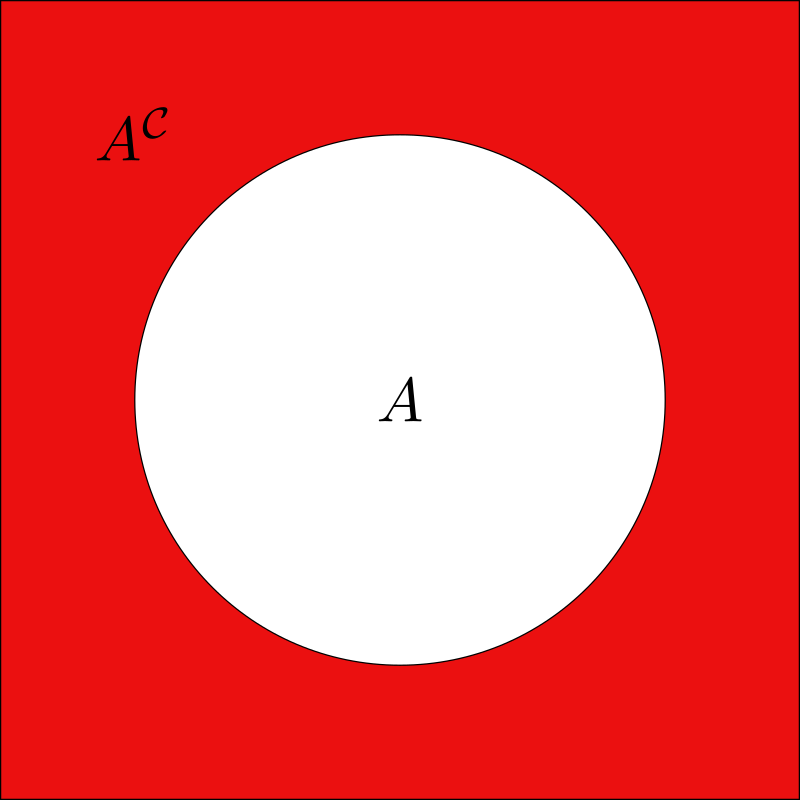
Venn Diagram of Complement
Claim: De Morgan's laws
Let \(A, B\) and \(C\) be sets, and let \(\mathcal{U}\) be a world of \(\left\{A, B\right\}\), then,- \(\left(A\cup B\right)^{{\cal C}}=A^{{\cal C}}\cap B^{{\cal C}}\)
- \(\left(A\cap B\right)^{{\cal C}}=A^{{\cal C}}\cup B^{{\cal C}}\)
- \(A\backslash\left(B\cup C\right)=\left(A\backslash B\right)\cap\left(A\backslash C\right)\)
- \(A\backslash\left(B\cap C\right)=\left(A\backslash B\right)\cup\left(A\backslash C\right)\)
Proof
-
Let \(x\) be an object, to prove this, we use the definition of the complement, and De Morgan's laws for logical connectives,
\[ \begin{align*} x \in (A \cup B)^{\mathcal{C}} & \iff x \in \mathcal{U} \land x \notin (A \cup B) \\ & \iff x \in \mathcal{U} \land \neg(x \in A \lor x \in B) \\ & \iff x \in \mathcal{U} \land (x \notin A \land x \notin B) && \text{(Logical De Morgan)} \\ & \iff (x \in \mathcal{U} \land x \notin A) \land (x \in \mathcal{U} \land x \notin B) \\ & \iff x \in A^{\mathcal{C}} \land x \in B^{\mathcal{C}} \\ & \iff x \in A^{\mathcal{C}} \cap B^{\mathcal{C}} \end{align*} \]Thus, \(\left(A\cup B\right)^{{\cal C}}=A^{{\cal C}}\cap B^{{\cal C}}\).
-
Let \(x\) be an object, to prove this, we use the definition of the complement, and De Morgan's laws for logical connectives,
\[ \begin{align*} x \in (A \cap B)^{\mathcal{C}} & \iff x \in \mathcal{U} \land x \notin (A \cap B) \\ & \iff x \in \mathcal{U} \land \neg(x \in A \land x \in B) \\ & \iff x \in \mathcal{U} \land (x \notin A \lor x \notin B) && \text{(Logical De Morgan)} \\ & \iff (x \in \mathcal{U} \land x \notin A) \lor (x \in \mathcal{U} \land x \notin B) && \text{(Distributivity)} \\ & \iff x \in A^{\mathcal{C}} \lor x \in B^{\mathcal{C}} \\ & \iff x \in A^{\mathcal{C}} \cup B^{\mathcal{C}} \end{align*} \]Thus, \(\left(A\cap B\right)^{{\cal C}}=A^{{\cal C}}\cup B^{{\cal C}}\).
-
Let \(x\) be an object, then,
\[ \begin{align*} x \in A \setminus (B \cup C) & \iff x \in A \land x \notin (B \cup C) \\ & \iff x \in A \land \neg(x \in B \lor x \in C) \\ & \iff x \in A \land (x \notin B \land x \notin C) && \text{(Logical De Morgan)} \\ & \iff (x \in A \land x \notin B) \land (x \in A \land x \notin C) && \text{(Idempotency)} \\ & \iff x \in (A \setminus B) \land x \in (A \setminus C) \\ & \iff x \in (A \setminus B) \cap (A \setminus C) \end{align*} \] -
Let \(x\) be an object, then,
\[ \begin{align*} x \in A \setminus (B \cap C) & \iff x \in A \land x \notin (B \cap C) \\ & \iff x \in A \land \neg(x \in B \land x \in C) \\ & \iff x \in A \land (x \notin B \lor x \notin C) && \text{(Logical De Morgan)} \\ & \iff (x \in A \land x \notin B) \lor (x \in A \land x \notin C) && \text{(Distributivity)} \\ & \iff x \in (A \setminus B) \lor x \in (A \setminus C) \\ & \iff x \in (A \setminus B) \cup (A \setminus C) \end{align*} \]
Symmetric Difference🔗
Definition: Symmetric Difference
Let \(A\) and \(B\) be sets, then,
And as a Venn diagram,
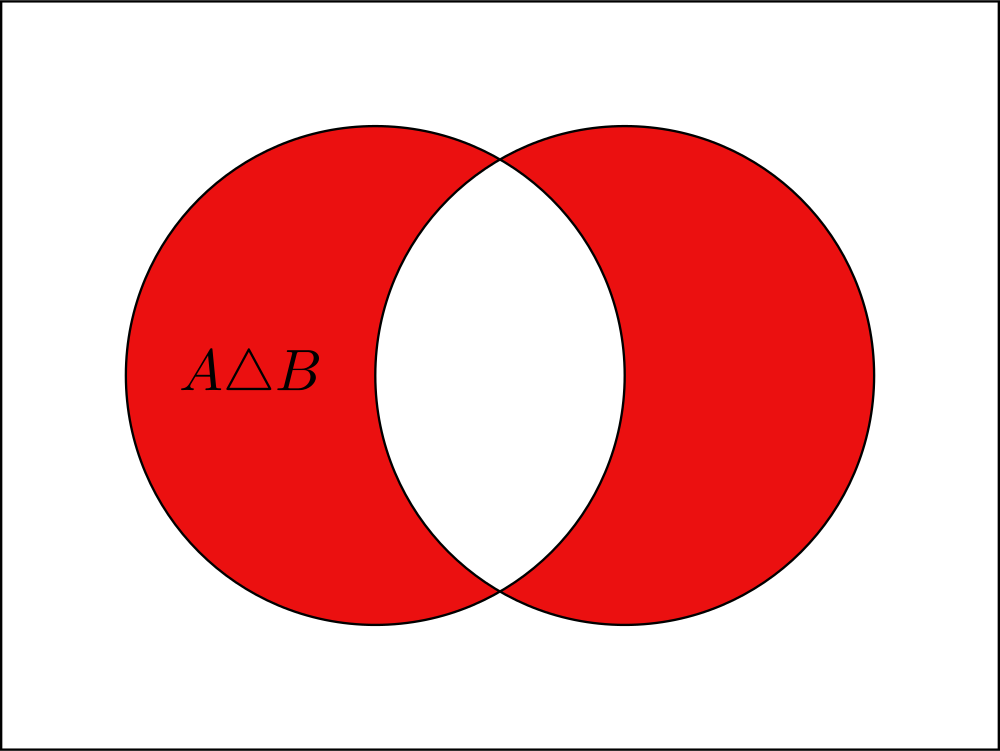
Venn Diagram of Symmetric Difference
There are a lot of variations to the definition of the symmetric difference, hence we will prove that they are all equivalent, and from now on won't worry about the specific definition we use in each instance.
Theorem: Alternative Definitions of the Symmetric Difference
Let \(A\) and \(B\) be sets, and let \(\mathcal{U}\) be a world of \(\left\{A, B\right\}\), then,
- \(A\triangle B=\left(A\backslash B\right)\cup\left(B\backslash A\right)\)
- \(A\triangle B = \left(A\cup B\right)\backslash\left(A\cap B\right)\)
- \(A\triangle B = \left(A \cap B^\mathcal{C}\right) \cup \left(A^\mathcal{C} \cap B\right)\)
- \(A\triangle B = \left(A\cup B\right)\cap\left(A^\mathcal{C}\cup B^\mathcal{C}\right)\)
Proof
We will prove these identities by showing that the membership conditions for each set are logically equivalent to the definition of the symmetric difference,
-
Let \(x\) be an object. By the definition of union and difference,
\[ \begin{align*} x \in \left(A \setminus B\right) \cup \left(B \setminus A\right) & \iff \left(x \in A \land x \notin B\right) \lor \left(x \in B \land x \notin A\right) \\ & \iff \left(x \in A\right) \oplus \left(x \in B\right) \end{align*} \]Since \(\left(x \in A\right) \oplus \left(x \in B\right)\) implies that either \(x \in A\) or \(x \in B\), the condition \(x \in A \cup B\) is automatically satisfied. Thus, the identity holds.
-
Let \(x\) be an object. By the definition of difference,
\[ \begin{align*} x \in \left(A \cup B\right) \setminus \left(A \cap B\right) & \iff x \in \left(A \cup B\right) \land x \notin \left(A \cap B\right) \\ & \iff \left(x \in A \lor x \in B\right) \land \neg\left(x \in A \land x \in B\right) \end{align*} \]From propositional logic, we know that the condition is equivalent to \(\left(x \in A\right) \oplus \left(x \in B\right)\), and hence \(x \in A \cup B\), which is the definition of \(A \triangle B\).
-
Let \(x\) be an object. Since \(\mathcal{U}\) is a world of \(\{A, B\}\), we have \(A \subseteq \mathcal{U}\) and \(B \subseteq \mathcal{U}\). Using the definition of intersection and complement,
\[ \begin{align*} x \in \left(A \cap B^{\mathcal{C}}\right) \cup \left(A^{\mathcal{C}} \cap B\right) & \iff \left(x \in A \land x \in B^{\mathcal{C}}\right) \lor \left(x \in A^{\mathcal{C}} \land x \in B\right) \\ & \iff \left(x \in A \land x \notin B\right) \lor \left(x \notin A \land x \in B\right) \end{align*} \]This is identical to the logic in part 1, which we already showed is equivalent to \(A \triangle B\).
-
Let \(x\) be an object. By the De Morgan's laws for sets, we know that \(A^{\mathcal{C}} \cup B^{\mathcal{C}} = \left(A \cap B\right)^{\mathcal{C}}\). Substituting this into the expression,
\[ \begin{align*} x \in \left(A \cup B\right) \cap \left(A^{\mathcal{C}} \cup B^{\mathcal{C}}\right) & \iff x \in \left(A \cup B\right) \cap \left(A \cap B\right)^{\mathcal{C}} \\ & \iff x \in \left(A \cup B\right) \setminus \left(A \cap B\right) \end{align*} \]This is identical to the logic in part 2, which we already showed is equivalent to \(A \triangle B\).
Since the membership conditions for all four expressions are equivalent to the definition of the symmetric difference, the theorem is proved.
Example
Try to understand why the following is true,
- \(\left\{ 1,2,3\right\} \triangle\left\{ 3,4,5,6\right\} =\left\{ 1,2,5,6\right\}\)
- \(\left\{ \left\{ 1\right\} \right\} \triangle\left\{ 1\right\} =\left\{ \left\{ 1\right\} ,1\right\}\)
- \(\left\{ 3,4\right\} \triangle\left\{ 3,4,5\right\} =\left\{ 5\right\}\)
Exercise: Symmetric Difference is Associative
Let \(A, B\) and \(C\) be sets, then,
Solution
From the definition of the set construction schemes, and from the definition of the symmetric difference, we get that,
and note that we used the fact that union and xor are associative.
Claim: Symmetric Difference is Commutative
Let \(A\) and \(B\) be sets, then,
Proof
Claim
Let \(A\) be a set, then,
Proof
Thus, \(A \triangle A = \emptyset\).
Exercise
Let \(A\) be a set, then,
Solution
Thus, \(A \triangle \emptyset = A\).
Exercise
Let \(A, B\) and \(C\) be sets, then,
Solution
We assume that \(A \triangle B = B \triangle C\). then we get that,
Now by the commutativity of the symmetric difference,
And by the associativity of the symmetric difference,
Then by the last claim we saw, we get that,
And by the last exercise we saw, we get that,
as required.
Power Set🔗
Definition: Power Set (Non formal)
Let \(A\) be a set, then,
But this definition doesn't adhere to our set construction schemes, hence we need to somehow know in the definition from which set are all the \(B\)s come from, but this is cyclic problem since the power set is exactly the set from which we would have wanted to draw the \(B\)s from. Because of that, to define this operation in our theory we have to an axiom that allows us to use the power set,
Axiom: Axiom of Power Set
Let \(A\) be a set, then there exists a set \(\mathcal{Q}\), such that,
and we call such a set \(\mathcal{Q}\) a power set world of \(A\).
Before we define the power set we want to show that it will be well defined,
Theorem: Power Set is Well Defined
Let \(A\) be a set, and let \(\mathcal{Q}, \mathcal{R}\) be power set worlds of \(A\), then,
Proof
Let
this means \(X \in \mathcal{Q}\) and \(X \subseteq A\).
Since \(X \subseteq A\), by the definition of the power set world \(\mathcal{R}\), we must have \(X \in \mathcal{R}\). Thus,
And the reverse containment holds by symmetry and WLoG by swapping \(\mathcal{Q}\) and \(\mathcal{R}\). Therefore, the power set is well defined.
And now we can define the power set formally,
Definition: Power Set
Let \(A\) be a set, and let \(\mathcal{Q}\) be a power set world of \(A\), then,
Because we know that the union is well defined, we will omit the power set world \(\mathcal{Q}\) from now on, because it doesn't provide us with any information.
Example
Try to understand why the following is true,
- \(\mathcal{P}\left(\emptyset\right)=\left\{ \emptyset\right\}\)
- \(\mathcal{P}\left(\left\{ 1,2\right\} \right)=\left\{ \emptyset,\left\{ 1\right\} ,\left\{ 2\right\} ,\left\{ 1,2\right\} \right\}\)
Exercise
Let \(A\) and \(B\) be sets, then,
Proof
We'll prove this exercise using two-directional implication,
- \(\underline{\implies}\): We assume that \(A \subseteq B\). Let \(X \in \mathcal{P}(A)\), then \(X \subseteq A\), and by transitivity, \(X \subseteq B\), so \(X \in \mathcal{P}(B)\). Thus \(\mathcal{P}(A) \subseteq \mathcal{P}(B)\).
- \(\underline{\impliedby}\): We assume that \(\mathcal{P}(A) \subseteq \mathcal{P}(B)\). Since \(A \subseteq A\), we have \(A \in \mathcal{P}(A)\), and by our assumption, \(A \in \mathcal{P}(B)\), which means \(A \subseteq B\).
Theorem (Not formal)
Let \(A\) be a finite set, then,
Proof
Let \(A\) be a finite set, then we will denote \(\left|A\right|=n\in\mathbb{N}\) and therefore it holds that \(A=\left\{ a_{1}\ldots a_{n}\right\}\). Let us notice that every subset of \(A\) can be described in the following way: "every element in \(A\) will tell us whether it is located in the subset or not", for example the set \(\emptyset\) describes the case in which no element of \(A\) enters the set, on the other hand \(\left\{ a_{2},a_{7}\right\}\) describes the case in which \(a_{2},a_{7}\) entered the set and the rest of the elements did not (verify that you understand why this process returns all the subsets of \(A\)), now let us notice that in every such subset, for every element there are two possibilities, to choose to enter or not, and therefore the amount of subsets is \(\underbrace{2\cdot2\cdot\ldots\cdot2}_{n\text{ elements}}=2^{n}\). In particular we will get that \(\left|\mathcal{P}\left(A\right)\right|=2^{\left|A\right|}\).
Exercise
Compute the following sets (meaning find a canonical way to write them without the power set),
- \(\left\{ X\backslash\left\{ 0\right\} \mid X\in\mathcal{P}\left(\bbn\right)\right\}\)
- \(\left\{ \left\{ 0\right\} \backslash X\mid X\in\mathcal{P}\left(\bbn\right)\right\}\)
- Let \(A\) be a set, what is \(\bigcup\mathcal{P}\left(A\right)\)?
- Let \(A\) be a set, what is \(\bigcap\mathcal{P}\left(A\right)\)?
Solution
-
We want to show that,
\[\left\{ X\backslash\left\{ 0\right\} \mid X\in\mathcal{P}\left(\bbn\right)\right\} = \mathcal{P}(\bbn \backslash \{0\})\]-
\(\underline{\subseteq}\): Let
\[Y \in \{ X \setminus \{0\} \mid X \in \mathcal{P}(\bbn) \}\]Then there exists a set \(X\subseteq \bbn\) such that \(Y = X \setminus \{0\}\).
Meaning that, \(Y \subseteq \bbn\) and \(0 \notin Y\), so \(Y \subseteq \bbn \setminus \{0\}\), hence,
\[Y \in \mathcal{P}(\bbn \backslash \{0\})\] -
\(\underline{\supseteq}\): Let \(Y \in \mathcal{P}(\bbn \backslash \{0\})\), then \(Y \subseteq \bbn \setminus \{0\}\). Since \(Y \subseteq \bbn\) and \(Y = Y \setminus \{0\}\), we get that,
\[Y\in \left\{ X\backslash\left\{ 0\right\} \mid X\in\mathcal{P}\left(\bbn\right)\right\}\]
-
-
We want to show that,
\[\left\{ \left\{ 0\right\} \backslash X\mid X\in\mathcal{P}\left(\bbn\right)\right\} = \left\{\emptyset, \left\{0\right\}\right\}\]-
\(\underline{\subseteq}\): Let
\[Y\in \left\{ \left\{ 0\right\} \backslash X\mid X\in\mathcal{P}\left(\bbn\right)\right\}\]Then, there exists a set \(X\in\mathcal{P}\) such that, \(Y = \left\{0\right\}\backslash X\), then by the definition of difference, we get that \(Y\subseteq\left\{0\right\}\), hence,
\[Y \in \mathcal{P}\left(\left\{0\right\}\right) = \left\{\emptyset, \left\{0\right\}\right\}\] -
\(\underline{\supseteq}\): We want to show that,
\[\left\{ \left\{ 0\right\} \backslash X\mid X\in\mathcal{P}\left(\bbn\right)\right\} \supseteq \left\{\emptyset, \left\{0\right\}\right\}\]meaning that we want to show that,
\[\left(\emptyset\in\left\{ \left\{ 0\right\} \backslash X\mid X\in\mathcal{P}\left(\bbn\right)\right\} \right)\land\left(\left\{ 0\right\} \in\left\{ \left\{ 0\right\} \backslash X\mid X\in\mathcal{P}\left(\bbn\right)\right\} \right)\]For that, we will prove those two things separately,
-
We want to show that,
\[\emptyset\in\left\{ \left\{ 0\right\} \backslash X\mid X\in\mathcal{P}\left(\bbn\right)\right\}\]We define, \(X_0 \in \mathcal{P}\) as \(X_0 = \left\{0\right\}\), and note that,
\[\left\{0\right\} \backslash X_0 = \left\{0\right\} \backslash \left\{0\right\} = \emptyset\] -
We want to show that,
\[\left\{0\right\}\in\left\{ \left\{ 0\right\} \backslash X\mid X\in\mathcal{P}\left(\bbn\right)\right\}\]We define, \(X_1 \in \mathcal{P}\) as \(X_1 = \emptyset\), and note that,
\[\left\{0\right\} \backslash X_1 = \left\{0\right\} \backslash \emptyset = \left\{0\right\}\]
-
-
-
We want to show that,
\[\bigcup\mathcal{P}\left(A\right) = A\]- \(\underline{\subseteq}\): Let \(x \in \bigcup\mathcal{P}\left(A\right)\), meaning that there exists a set \(X\in \mathcal{P}\left(A\right)\) for which, \(x \in X\), but since \(X\subseteq A\), we get that \(x\in A\).
- \(\underline{\supseteq}\): Let \(x\in A\), then because \(A\subseteq A\) we get that \(A\in\mathcal{P}\left(A\right)\), hence \(x\in \bigcup\mathcal{P}\left(A\right)\).
-
We want to show that,
\[\bigcap\mathcal{P}\left(A\right) = \emptyset\]We note that \(\emptyset\subseteq \bigcap\mathcal{P}\left(A\right)\), hence we need to show only one directional containment.
We know that \(\emptyset \subseteq A\), hence \(\emptyset \in\mathcal{P}\left(A\right)\), and from the definition of the generalized intersection we get that,
\[\emptyset \subseteq \bigcap\mathcal{P}\left(A\right)\]